Office Experiment: Cookie Monster Receptionist

About a month ago I had an idea.

A stupid idea.

It was a wonderful, stupid idea.

Strolling into my company’s brand-spanking-new world headquarters early one Monday morning, something stuck out to me. It stuck out like a gun control advocate at a Ted Nugent concert. Or like Ted Nugent at a Mensa meeting.

Ya see, our new office has this massive reception desk. HUGE. As soon as you step off the elevator, there it is. Large, round, and – initially – unmanned. And while our company is growing (and actively hiring), having a dedicated receptionist is still a ways away.

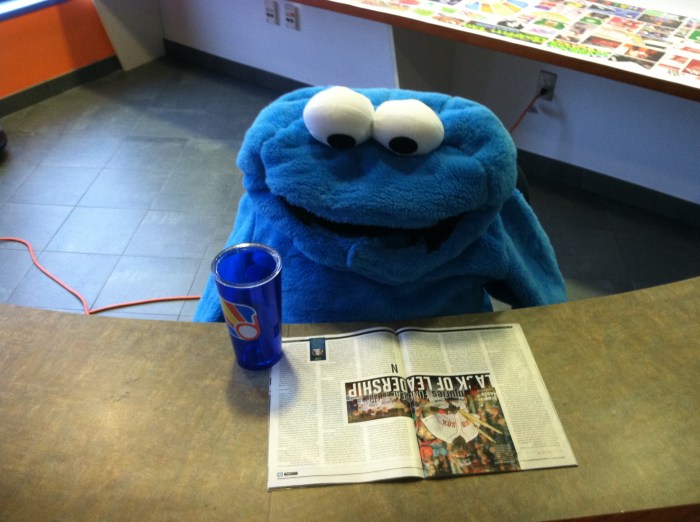
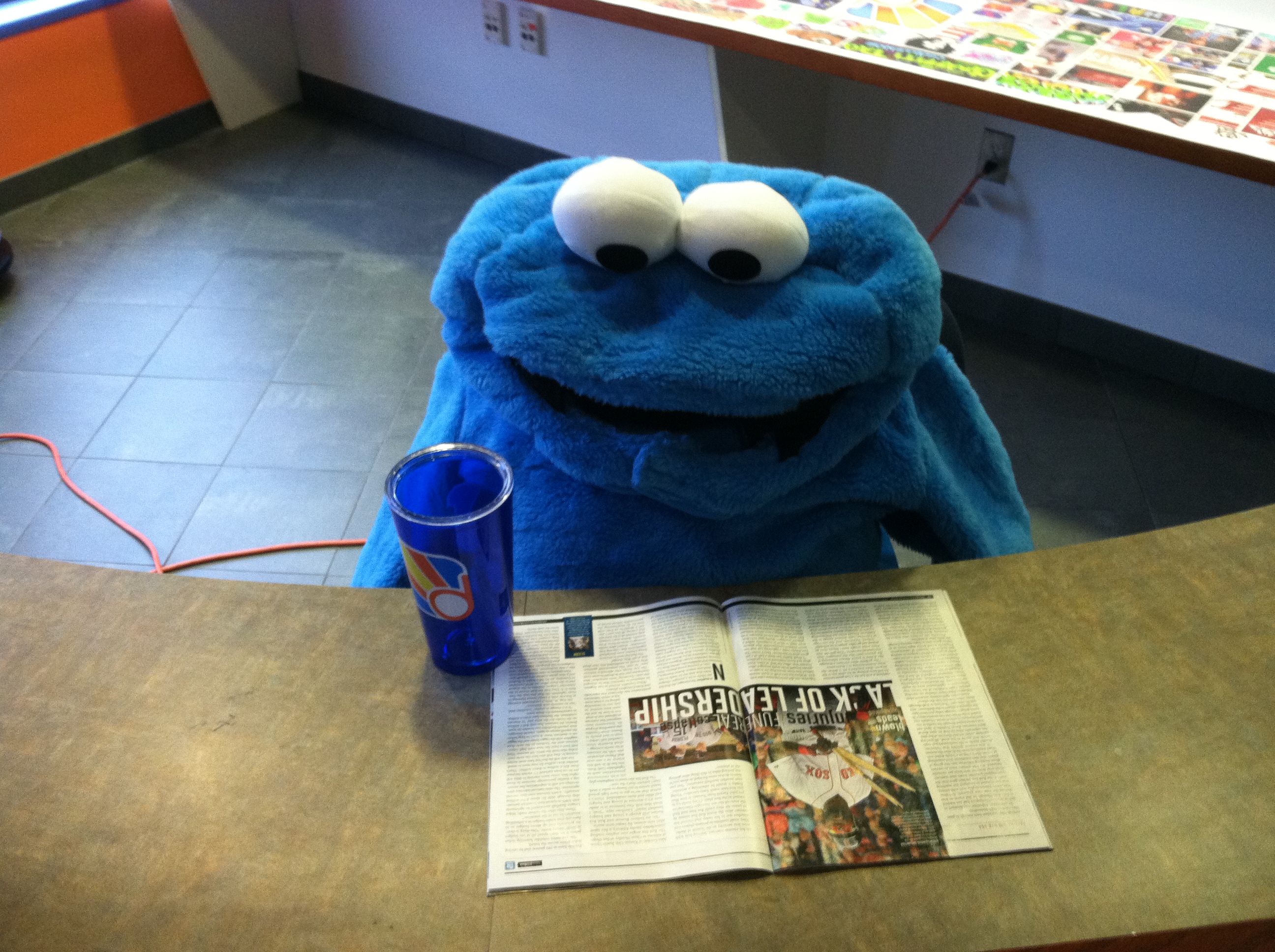
So, like any good employee would do, I went into our office’s storage room and rummaged through the costume box (your office doesn’t have a costume box? What?!?) until I found Cookie Monster.

Cookie Monster has now been sitting behind the reception desk for about a month, flipping through an old issue of Sports Illustrated. He doesn’t say much, though. And he rarely answers the phone. Still, if you’re looking for a receptionist, I highly recommend Mr. Monster. He’s the first one here each morning and the last one to leave each night – no exceptions. Now THAT is dedication.


Writer’s Block Remedies Part 4 of 4 (Cap the Caffeine)

If you’re like me, you can’t start your day without a cup of strong, black coffee. And you usually can’t continue your day without – at least – one or two (or three) more cups.

When writing, I find there is a “caffeine balance” you can achieve, wherein you are alert and attentive, but not jittery or fidgety. Achieving this balance, however, will likely require that you drink less coffee as opposed to drinking more (which makes this tip/trick more of an inaction than an action).

According to Neel’s Corner, too much caffeine consumption causes you to feel stressed (and stressed writing is rarely ever your best writing). In addition, too much caffeine can potentially increase your blood pressure, putting you at risk for heart disease.

More writer’s block remedies:

Team Creativity Exercise: Inspirational Quotes

Whether they’re framed above the mantle, spelled out in magnetic poetry on the fridge, or scribbled on the inside of your office’s bathroom stall, quotes can have a huge impact on the way we think.

Quotes are the ultimate short-form prose, as they cut away the unnecessary (but tasty) fat and leave us with just the meat of an argument or idea. Easily digested and easily shared, quotes are a low-barrier-to-entry way of spreading knowledge.

Creativity Exercise: Inspirational Quotes

  • Put the quotes face-down on the table and have each participant pick one.
  • Go around the horn (participants read their quotes aloud).
  • Lead discussion by asking questions – e.g.
    • What was your favorite quote?
    • What was your least favorite quote?
    • Which quotes had similar messages?
    • Which quotes were most at odds with each other?
    • What does the ___ quote mean?

    (Tip: Encourage participants to re-read their quotes as needed.)

What’s the point?

Think Different: Tackling the tasks required of you each day (while obviously a necessity) can get your brain stuck in a certain way of thinking. Discussing ideas from some of history’s most creative minds will encourage your brain to think in different ways and can help spark creativity.

Get Talking: Running this exercise is a great way to generate a good – dare I say, “academic” – discussion. (When I ran the exercise, the discussion in the room came to revolve around whether or not the term “creativity” implied something entirely unique/invented or the connecting of ideas/components in novel ways.)