Team Creativity Exercise: Inspirational Quotes

Whether they’re framed above the mantle, spelled out in magnetic poetry on the fridge, or scribbled on the inside of your office’s bathroom stall, quotes can have a huge impact on the way we think.

Quotes are the ultimate short-form prose, as they cut away the unnecessary (but tasty) fat and leave us with just the meat of an argument or idea. Easily digested and easily shared, quotes are a low-barrier-to-entry way of spreading knowledge.

Creativity Exercise: Inspirational Quotes

  • Put the quotes face-down on the table and have each participant pick one.
  • Go around the horn (participants read their quotes aloud).
  • Lead discussion by asking questions – e.g.
    • What was your favorite quote?
    • What was your least favorite quote?
    • Which quotes had similar messages?
    • Which quotes were most at odds with each other?
    • What does the ___ quote mean?

    (Tip: Encourage participants to re-read their quotes as needed.)

What’s the point?

Think Different: Tackling the tasks required of you each day (while obviously a necessity) can get your brain stuck in a certain way of thinking. Discussing ideas from some of history’s most creative minds will encourage your brain to think in different ways and can help spark creativity.

Get Talking: Running this exercise is a great way to generate a good – dare I say, “academic” – discussion. (When I ran the exercise, the discussion in the room came to revolve around whether or not the term “creativity” implied something entirely unique/invented or the connecting of ideas/components in novel ways.)
Writer’s Block Remedies Part 3 of 4 (Go-a-Rovin’)

Our early human ancestors were rovers. They walked for miles and miles, following game animals, picking berries and – more generally – scouring the Earth for sustenance. They did not sit at that same desk, looking at that same ugly desk lamp and that same pointless container full of ballpoint pens that can no longer write.

Instead, early homo sapiens were encountering new views and vistas all the time, with their brains constantly reacting to the colors and details of their surroundings.

Today, roving for writer’s block can be as simple as transporting yourself and your laptop to a park bench or even to a different corner of the office/room. The point is to stimulate your brain with new surroundings when you feel writer’s block setting in.

More writer’s block remedies:

Writer’s Block Remedies Part 2 of 4 (Walk for Words)

While stretching is a physical writer’s block remedy that you can complete at your desk (see Writer’s Block Remedies Part 1), going out for a walk will provide your brain with a bigger boost.

Walking increases breathing and heart rate, which forces more energy-enhancing, oxygenated blood up to thirsty brain cells. In addition, walking can help you pump up your brain muscles, or more accurately, encourage “cerebral blood vessels to grow,” as The Franklin Institute notes.

So the next time your brain is idling in front of a blank page, put your body into gear and go for a walk around the block.

More writer’s block remedies:

Team Creativity Exercise: Draw Your Neighbor

“I’m just not that creative,” is a phrase that should never, ever be uttered…anywhere. But at a startup, especially one that produces interactive online content, being a self-proclaimed “uncreative person” should be a mortal sin.

Fiction: Creativity is an innate form of intelligence, which exists in finite amounts.

Fact: You can practice creativity and get better at it.

I’ve recently started leading my company’s content team (content writers & graphic designers) in creativity exercises. Each week, during our team meeting, we take about 10 to 15 minutes to complete an exercise that forces us to flex our creativity muscles.

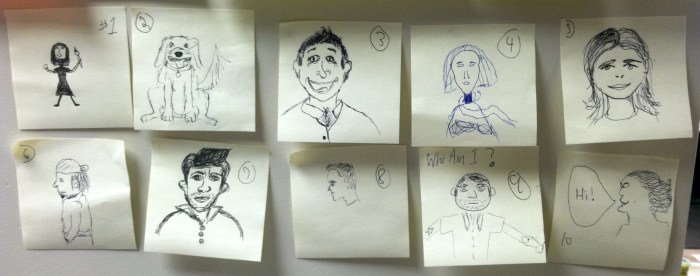
Creativity exercise: Draw Your Neighbor

How it works:

  • Each person is instructed to sketch the person to his or her right (no peeking allowed!)
  • After five minutes or so of sketching, all of the sketches are mixed up and put in a pile in the middle of the table
  • Each sketch is held up (and numbered) and participants jot down who they think is portrayed in each sketch
  • Next, participants go around the table and read off who they had for #1, #2, etc.
  • After everyone has made their guesses public for a particular sketch, the artist of the sketch can reveal who the right answer is

What’s the point?

Visualization: By completing a five-minute sketch, you’re practicing visualizing your ideas under a time constraint (think of brainstorms…you have five minutes to sketch out your idea for this project…)

Exit the Comfort Zone: Not everyone likes to sketch. And as you can tell by the examples I provided, not everyone is very good at sketching. By “forcing” such people to give it their best shot, you’re forcing their brains to think in a new way.

Writer’s Block Remedies Part 1 of 4 (Stretch for Syllables)

Your brain is hardwired to your body. In addition to coming in contact with other neurons, the neurons in your brain come in contact with skeletal muscles at a structure known as the neuromuscular junction.As a result, activating your muscles, such as through some simple stretching exercises, will activate brain receptors and help improve the connections between brain synapses. (Translation: It will give your brain a boost.)

Purdue University’s Online Writing Lab recommends tensing and releasing different muscle groups in the body for between 5 and 10 seconds at a time, starting with your feet.

Getting Physical with Your Writing: Tips and Tricks for Actively Battling Writer’s Block

So there you are, sitting anxiously at your computer, staring into the abyss of its illuminated screen while trying to convince your brain that it’s time to write. For whatever reason, your trusty brain is on strike. All fours lobes of its cerebral cortex (frontal, temporal, occipital and parietal), its cerebellum, its stem and yes even its limbic system have unionized and decided that today, at this very moment, you shall not be doing any writing.

As a content writer, I’ve had my battles with writer’s block and have occasionally turned to online resources for help. The majority of these resources recommend psychological solutions: brainstorm your ideas, organize your thoughts, swap out your negative thoughts with positive ones. For me, however, writer’s block will typically set in after completing these mental remedies. I’ll have a fully-researched, organized page; my fingers will be lined up on the keys ready to strike; my mind in a state of complete positivity. And then, nothing. When the only thing left for a writer to do is write, but the writer can’t write, what does a writer do?