Team Creativity Exercise: Redesigning the Quarter


Coins. They rattle in our pockets. They roll clumsily into Coke machines. And – when compassion permits – they fall into tip jars as well as hats and cups that line city sidewalks.

But coins are more than just pieces of metal that denote monetary value: they’re pieces of content that carry creative value.

Coins have copy. Some is informative (“Quarter Dollar”), some promotes our country’s values (“Liberty”), and some even makes religious assertions (“In God We Trust”). Coins also have design elements. Some of these designs commemorate our Founding Fathers, while others showcase the cultural capital of specific states.

Creativity Exercise: Redesign the Quarter (and/or Other Coins)

  • Prior to meeting with your group, grab a pen, some sticky notes, and a coffee mug (or other round object) and trace out a bunch of circles. These circles will serve as templates for your coins.
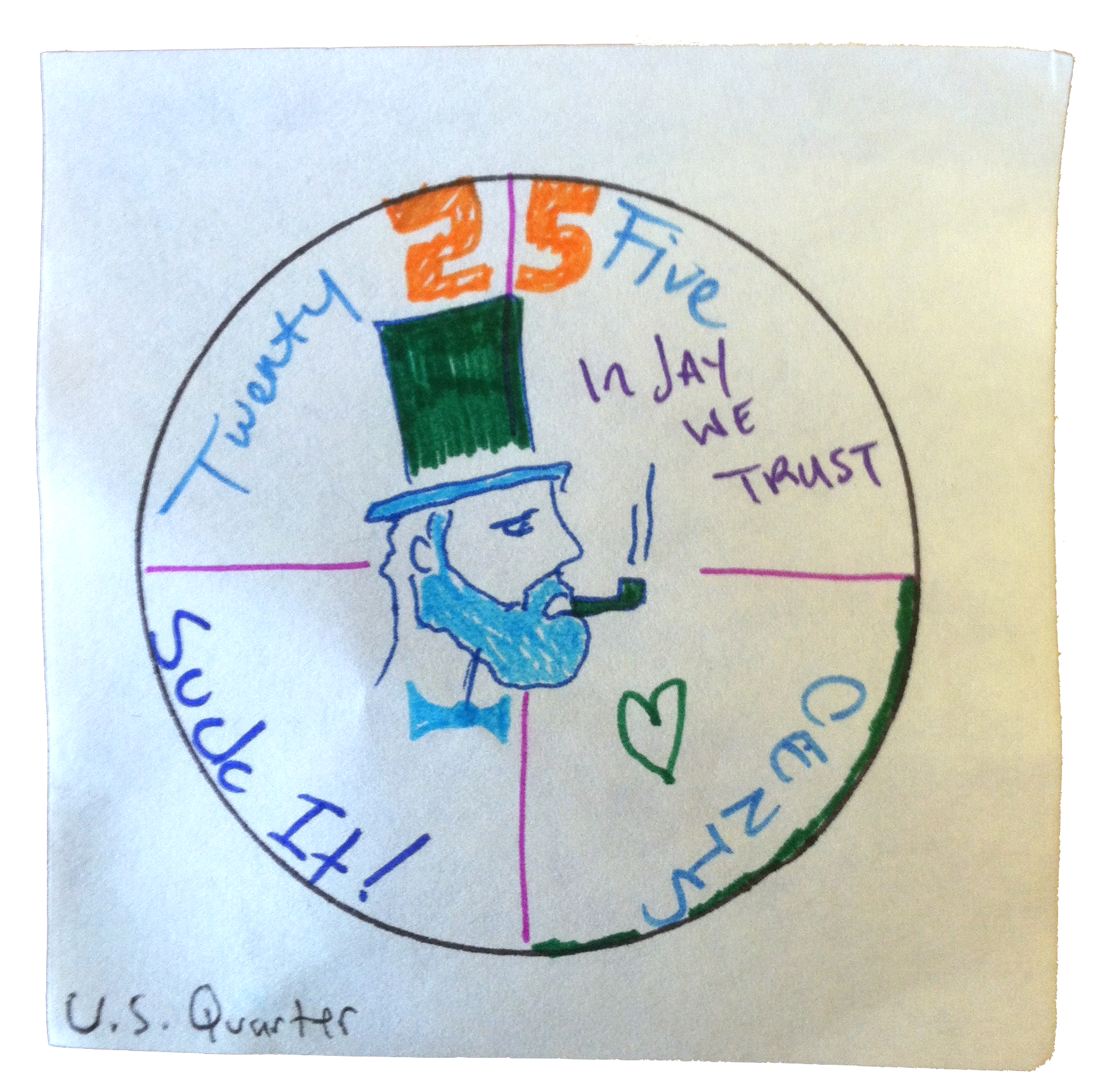
  • Pass out markers, pens, or pencils to participants and announce which coins they’ll be redesigning. (I had my group redesign three coins: the quarter, the Chuck E. Cheese token, and our company’s virtual currency.)
  • Allow each participant 10 seconds to add one element (copy or design) to each of the coins. A coin’s design is complete once everyone has contributed an element.
  • Hold up the coins for all to see and have participants weigh in on which coins they like best.

What’s the point?

Collaboration: This exercise allows for free collaboration – no one plans out ahead of time what the designs will look like. Instead, ideas flow freely and elements appear on the coins spontaneously.

Timed Creativity: Allowing only 10 seconds for each element to be added to the coins really puts participants on the spot. It forces participants to be creative while also adhering to a tight deadline, which – as you might know – can be difficult.

Some Like It Hot Sauce

Let’s not beat around the jalapeno bush here: I am addicted to hot sauce. I – quite literally – put that sh*t on everything. Salads, soups, burgers, burritos: You name a food that isn’t ice cream and I’ve probably hosed it with hot sauce and shoved it in my face.

There’s some actual science behind this madness. When you burn your tastes buds with hot sauce, your body perceives it as pain and releases endorphins to counteract that pain. Those endorphins create a sense of euphoria and you essentially start getting high off hot sauce. Keeping that high requires just one thing: more hot sauce.

I’ve now reached the point where buying hot sauce off the shelf doesn’t do it for me. There’s too much food coloring. Too much mild. Not enough scalding insanity. So, this past weekend, I decided to pull a Breaking Bad. I bought a trailer, drove off into the desert, started cooking, and – in my opinion – ended up with a superior product.

How to Make Homemade Hot Sauce

Step 1: Roast a bunch of  hot peppers (I used habaneros), onions, garlic, and bell peppers in the oven for a while.

Step 2: Put all that roasted goodness in a food processor and add some lime juice, apple cider vinegar, shredded carrots, and whatever else you want.

Step 3: Vzzzzzzzzzzsssssssssssssshhhhhhhhhhhhhhhhhhh

Step 4: Put it in a bottle and give it a funny name. (I went with Erik’s Homemade Bumhole-Burning Habanero Hot Sauce.)

Happy hot-saucing.

Office Experiment: Cookie Monster Receptionist

About a month ago I had an idea.

A stupid idea.

It was a wonderful, stupid idea.

Strolling into my company’s brand-spanking-new world headquarters early one Monday morning, something stuck out to me. It stuck out like a gun control advocate at a Ted Nugent concert. Or like Ted Nugent at a Mensa meeting.

Ya see, our new office has this massive reception desk. HUGE. As soon as you step off the elevator, there it is. Large, round, and – initially – unmanned. And while our company is growing (and actively hiring), having a dedicated receptionist is still a ways away.

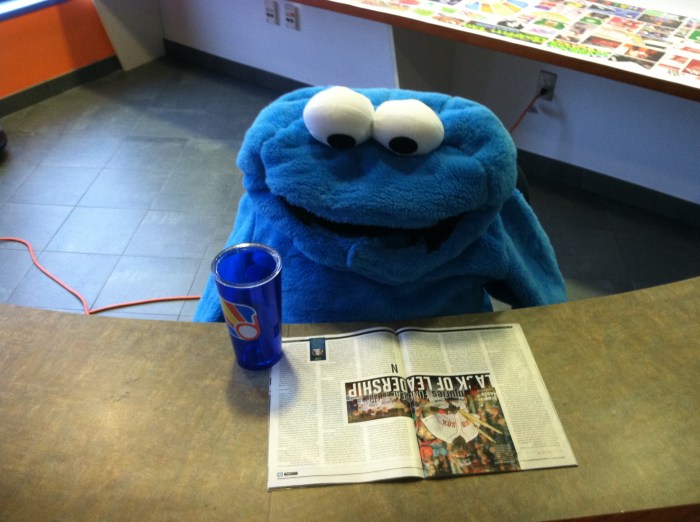
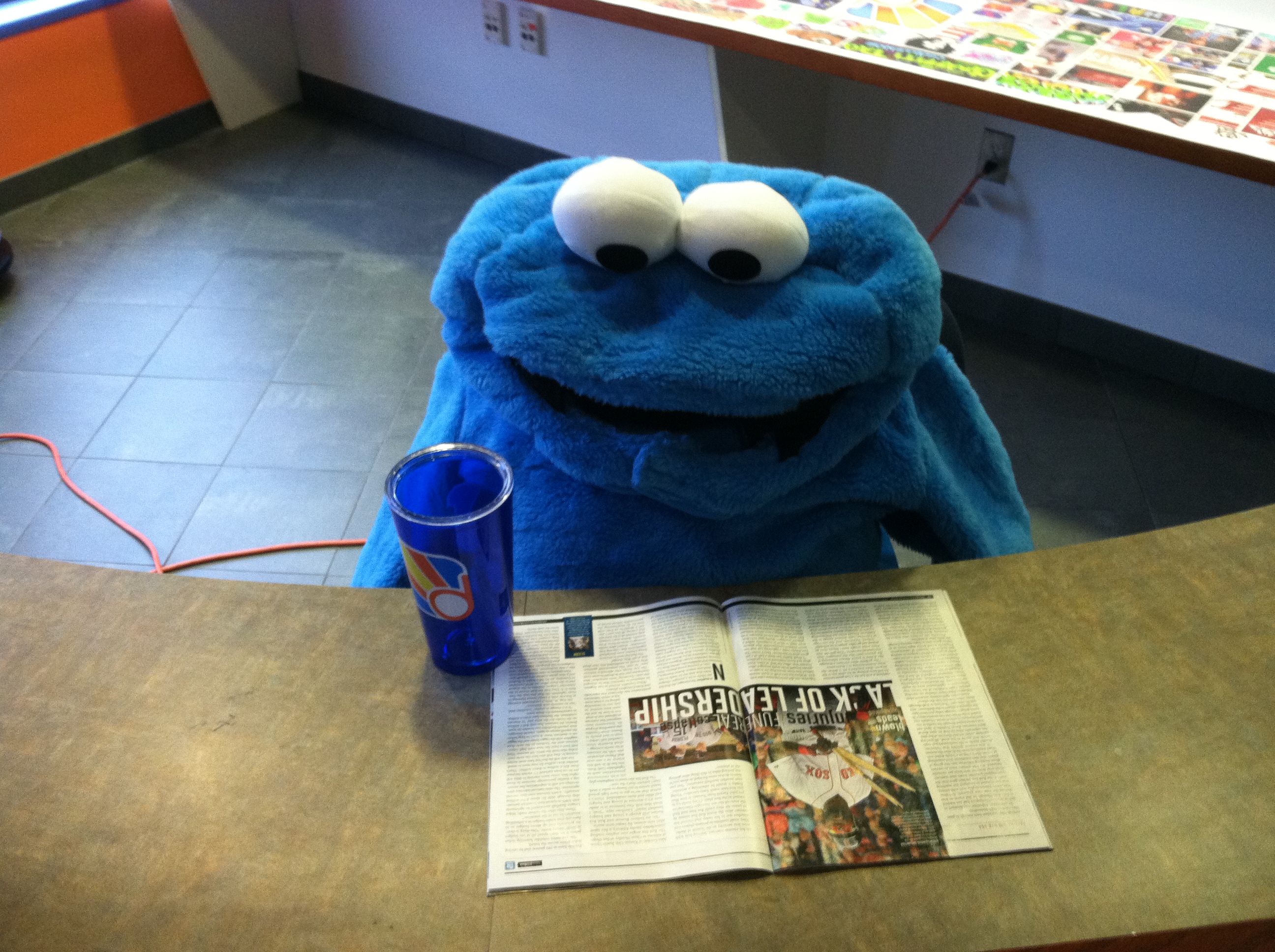
So, like any good employee would do, I went into our office’s storage room and rummaged through the costume box (your office doesn’t have a costume box? What?!?) until I found Cookie Monster.

Cookie Monster has now been sitting behind the reception desk for about a month, flipping through an old issue of Sports Illustrated. He doesn’t say much, though. And he rarely answers the phone. Still, if you’re looking for a receptionist, I highly recommend Mr. Monster. He’s the first one here each morning and the last one to leave each night – no exceptions. Now THAT is dedication.

Writer’s Block Remedies Part 4 of 4 (Cap the Caffeine)

If you’re like me, you can’t start your day without a cup of strong, black coffee. And you usually can’t continue your day without – at least – one or two (or three) more cups.

When writing, I find there is a “caffeine balance” you can achieve, wherein you are alert and attentive, but not jittery or fidgety. Achieving this balance, however, will likely require that you drink less coffee as opposed to drinking more (which makes this tip/trick more of an inaction than an action).

According to Neel’s Corner, too much caffeine consumption causes you to feel stressed (and stressed writing is rarely ever your best writing). In addition, too much caffeine can potentially increase your blood pressure, putting you at risk for heart disease.

More writer’s block remedies:

Team Creativity Exercise: Inspirational Quotes

Whether they’re framed above the mantle, spelled out in magnetic poetry on the fridge, or scribbled on the inside of your office’s bathroom stall, quotes can have a huge impact on the way we think.

Quotes are the ultimate short-form prose, as they cut away the unnecessary (but tasty) fat and leave us with just the meat of an argument or idea. Easily digested and easily shared, quotes are a low-barrier-to-entry way of spreading knowledge.

Creativity Exercise: Inspirational Quotes

  • Put the quotes face-down on the table and have each participant pick one.
  • Go around the horn (participants read their quotes aloud).
  • Lead discussion by asking questions – e.g.
    • What was your favorite quote?
    • What was your least favorite quote?
    • Which quotes had similar messages?
    • Which quotes were most at odds with each other?
    • What does the ___ quote mean?

    (Tip: Encourage participants to re-read their quotes as needed.)

What’s the point?

Think Different: Tackling the tasks required of you each day (while obviously a necessity) can get your brain stuck in a certain way of thinking. Discussing ideas from some of history’s most creative minds will encourage your brain to think in different ways and can help spark creativity.

Get Talking: Running this exercise is a great way to generate a good – dare I say, “academic” – discussion. (When I ran the exercise, the discussion in the room came to revolve around whether or not the term “creativity” implied something entirely unique/invented or the connecting of ideas/components in novel ways.)

Writer’s Block Remedies Part 3 of 4 (Go-a-Rovin’)

Our early human ancestors were rovers. They walked for miles and miles, following game animals, picking berries and – more generally – scouring the Earth for sustenance. They did not sit at that same desk, looking at that same ugly desk lamp and that same pointless container full of ballpoint pens that can no longer write.

Instead, early homo sapiens were encountering new views and vistas all the time, with their brains constantly reacting to the colors and details of their surroundings.

Today, roving for writer’s block can be as simple as transporting yourself and your laptop to a park bench or even to a different corner of the office/room. The point is to stimulate your brain with new surroundings when you feel writer’s block setting in.

More writer’s block remedies:

Writer’s Block Remedies Part 2 of 4 (Walk for Words)

While stretching is a physical writer’s block remedy that you can complete at your desk (see Writer’s Block Remedies Part 1), going out for a walk will provide your brain with a bigger boost.

Walking increases breathing and heart rate, which forces more energy-enhancing, oxygenated blood up to thirsty brain cells. In addition, walking can help you pump up your brain muscles, or more accurately, encourage “cerebral blood vessels to grow,” as The Franklin Institute notes.

So the next time your brain is idling in front of a blank page, put your body into gear and go for a walk around the block.

More writer’s block remedies:

Team Creativity Exercise: Draw Your Neighbor

“I’m just not that creative,” is a phrase that should never, ever be uttered…anywhere. But at a startup, especially one that produces interactive online content, being a self-proclaimed “uncreative person” should be a mortal sin.

Fiction: Creativity is an innate form of intelligence, which exists in finite amounts.

Fact: You can practice creativity and get better at it.

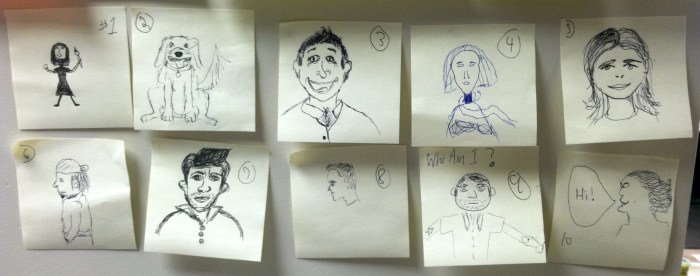
I’ve recently started leading my company’s content team (content writers & graphic designers) in creativity exercises. Each week, during our team meeting, we take about 10 to 15 minutes to complete an exercise that forces us to flex our creativity muscles.

Creativity exercise: Draw Your Neighbor

How it works:

  • Each person is instructed to sketch the person to his or her right (no peeking allowed!)
  • After five minutes or so of sketching, all of the sketches are mixed up and put in a pile in the middle of the table
  • Each sketch is held up (and numbered) and participants jot down who they think is portrayed in each sketch
  • Next, participants go around the table and read off who they had for #1, #2, etc.
  • After everyone has made their guesses public for a particular sketch, the artist of the sketch can reveal who the right answer is

What’s the point?

Visualization: By completing a five-minute sketch, you’re practicing visualizing your ideas under a time constraint (think of brainstorms…you have five minutes to sketch out your idea for this project…)

Exit the Comfort Zone: Not everyone likes to sketch. And as you can tell by the examples I provided, not everyone is very good at sketching. By “forcing” such people to give it their best shot, you’re forcing their brains to think in a new way.